Transforming Enterprise Activation
Turning a fragmented, months-long HCM implementation process into the foundation for a guided, integrated customer experience.
Ultimate Software
UX Design & Research Lead
2016 - 2017
Six-stage journey mapped | Phased platform strategy established | Foundation created for continued delivery | Platform later earned a Gold Stevie Award
The Question
During an enterprise HCM implementation, how could we reduce the time, effort, and uncertainty involved in moving a customer's HR and payroll data onto a new platform?
Customers needed to migrate hundreds-or sometimes hundreds of thousands-of employee records from systems that did not map directly to Ultimate's products.
Activation could take eight months or longer, even after customers had begun paying for the platform. The process relied on spreadsheets, disconnected tools, manual data translation, repeated validation, and extensive coordination between customers and implementation consultants. The process was costing the company millions in lost revenue.
My Contribution
I was recruited to lead UX for a newly formed cross-functional team. I partnered with the Product Owner on product strategy and the end-to-end experience, helped subject-matter experts transition into product development roles, led research and alignment efforts, and directed a supporting designer as the work moved into delivery.
Mapping the Current Experience
The first challenge was creating a shared understanding of a process that crossed teams, systems, and areas of expertise. I planned and facilitated a collaborative workshop in November 2016, bringing together the core team and stakeholders from services and product development to brainstorm and collect ideas.
We reviewed existing customer research, mapped the current process, and used collaborative exercises to connect operational knowledge with customer emotions and future possibilities. I then documented six stages: requirements collection, system configuration, data translation, data conversion, parallel payroll testing, and quality assurance.
The work exposed where disconnected tools, repeated questions, manual handoffs, and technical dependencies increased effort and risk. Most importantly, it showed that customers were effectively taking on a second job while trying to implement the product.
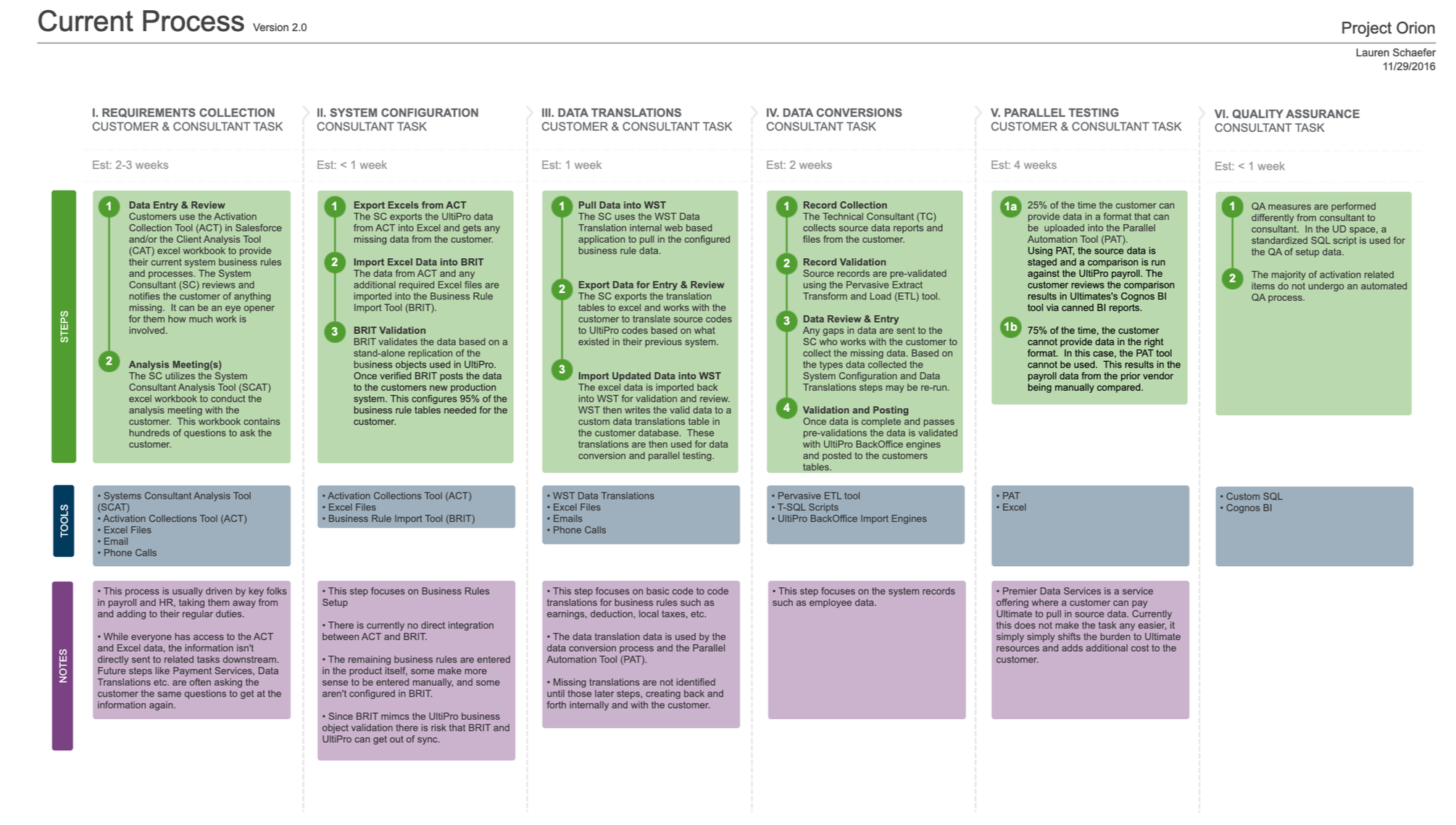
Current-state activation process across customers, consultants, tools, and six implementation stages
The Opportunity
Customers were effectively taking on a second job while trying to implement the product.
Most were completing this type of migration for the first time. They had to collect and validate sensitive information, learn unfamiliar terminology, coordinate with multiple specialists, and make high-stakes decisions-in addition to their normal responsibilities.
The opportunity was larger than consolidating tools. We needed to reduce customer effort while giving customers and consultants better visibility, guidance, and control.
Principles for a Better Activation
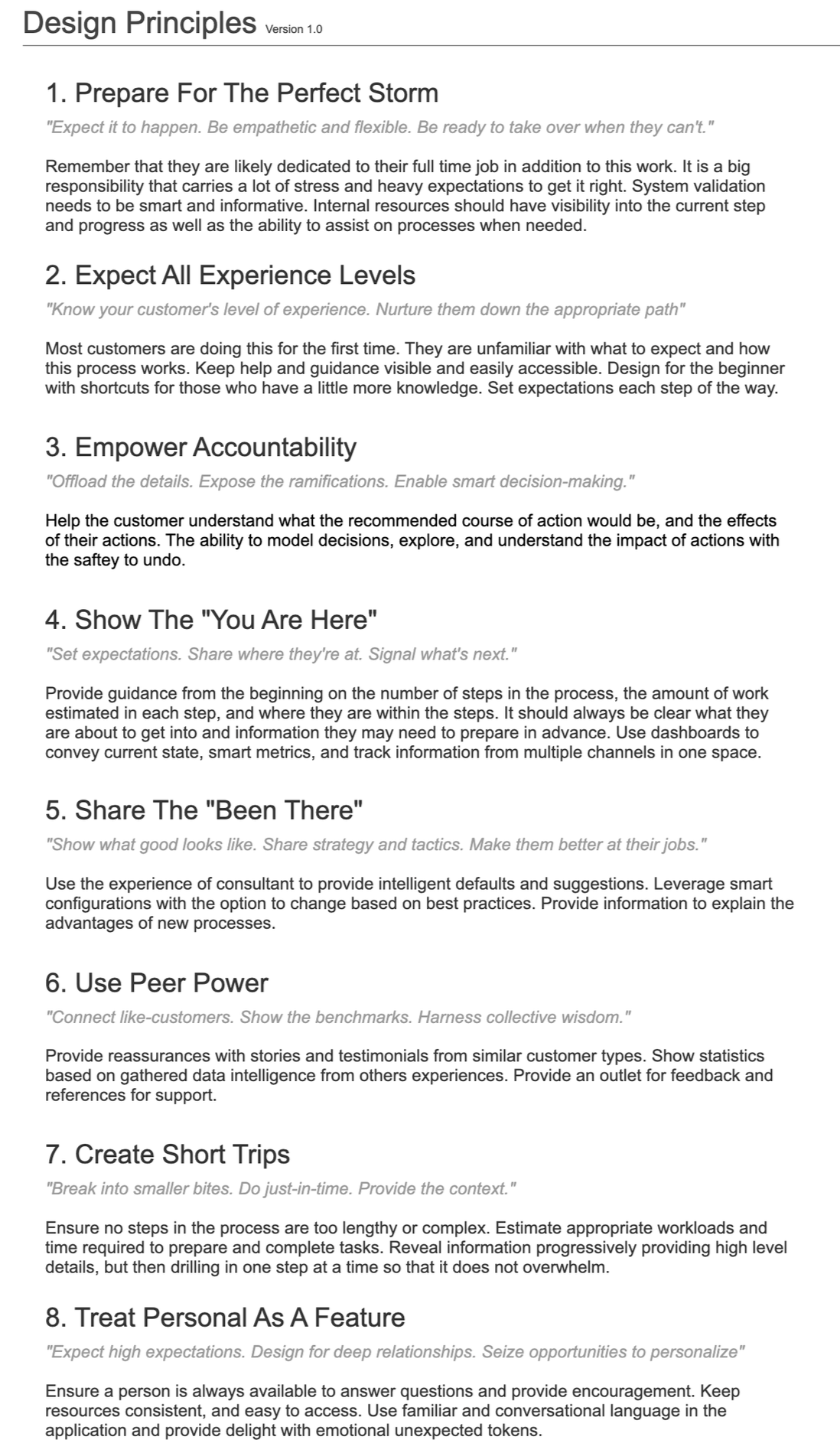
I translated research and process analysis into principles the broader team could use when making product decisions. The experience should:
Prepare for complexity and respond intelligently when problems occur.
Support customers with different levels of implementation experience.
Make progress, responsibilities, and next steps visible.
Apply expert guidance, smart defaults, and prior implementation knowledge.
Break a long, overwhelming process into shorter, manageable steps.
Combine automation with access to human support.
Key Decisions & Direction
Working with the Product Owner, subject-matter experts, and business analysts, I prioritized the workshop findings, helped define the high-level features, and converted the process analysis into a phased product direction.
Create one shared activation environment
Bring project status, tasks, files, communication, data work, and guidance into a coordinated experience for customers and implementation consultants.
Automate repetitive data work
Use file parsing, smart mapping, validation, and system recommendations to reduce manual entry and identify problems earlier.
Design for both sides of the service
Create a customer-facing journey supported by an internal consultant experience for configuration, review, troubleshooting, and oversight.
Make complexity understandable
Establish a customer hierarchy, project model, role structure, and navigation system that support multiple product implementations and subprojects.
Deliver the vision in phases
Focus the initial release on importing and validating setup data, then expand into configuration, employee-data migration, payroll simulation, and broader automation.
Concept vision demo video
Connecting the Pieces
I developed the application architecture, navigation model, customer and consultant workflows, initial concepts, and interface standards for the standalone platform. I also created a concept video and every screen shown in it to make the future experience tangible and build stakeholder support.
I created a style guide covering layout, navigation, tables, controls, system feedback, and reusable interaction patterns. During monthly feature cycles, I worked with business analysts on use cases and flows, then partnered with engineering and QA as stories moved into implementation.
At the end of features, I led or supported user-acceptance testing, usability studies, and interviews, using the feedback to refine the experience and keep personas current. I transitioned off the project in fall 2017, the core workflows and interface rules were established, enabling the supporting designer and development team to continue detailed delivery without reinterpreting the system each time.
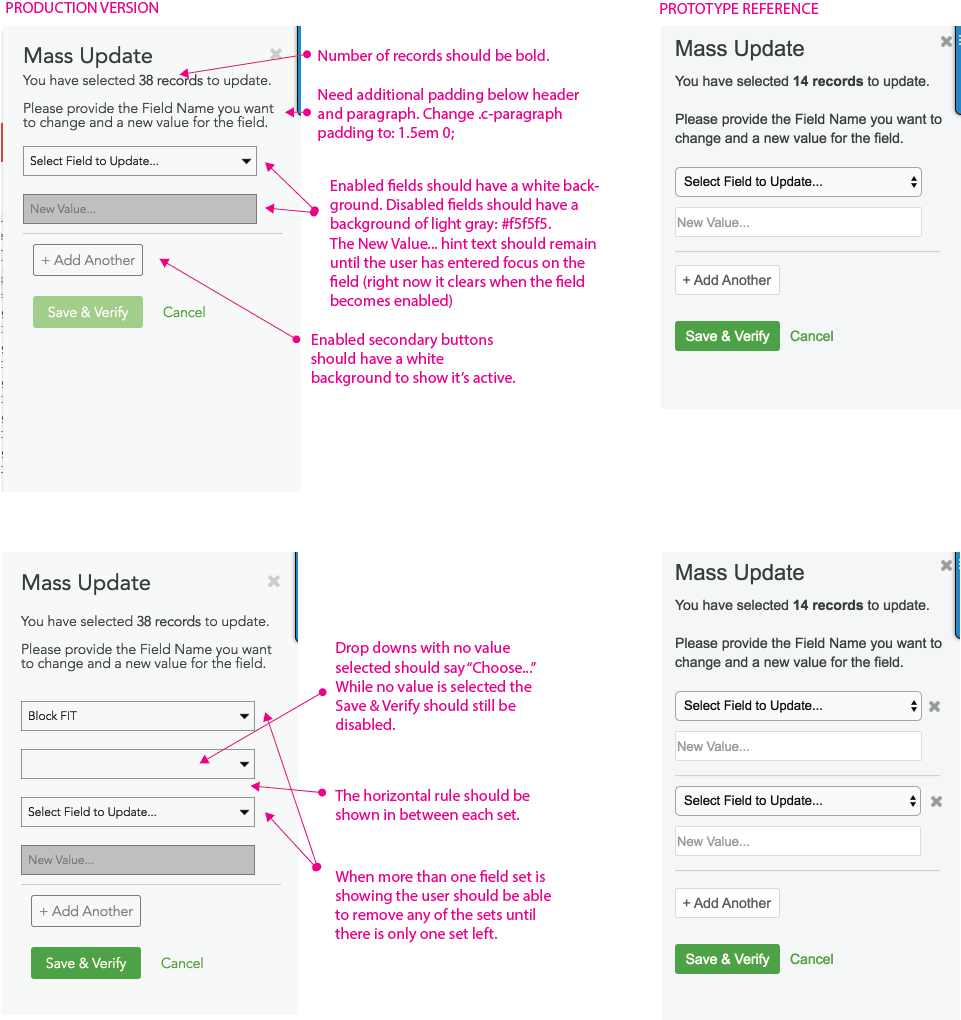
Edits for engineering during development
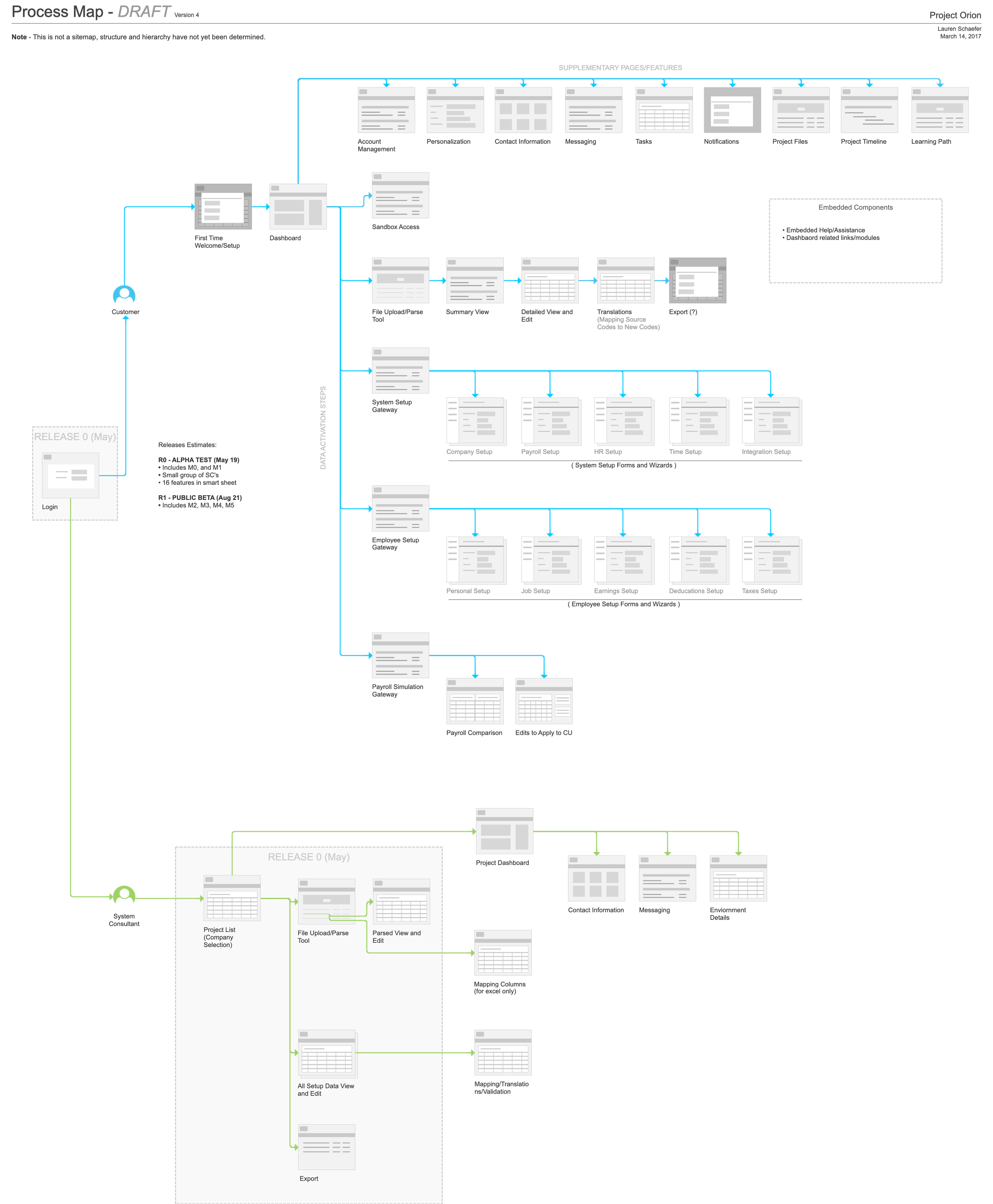
Experience Architecture Process Map
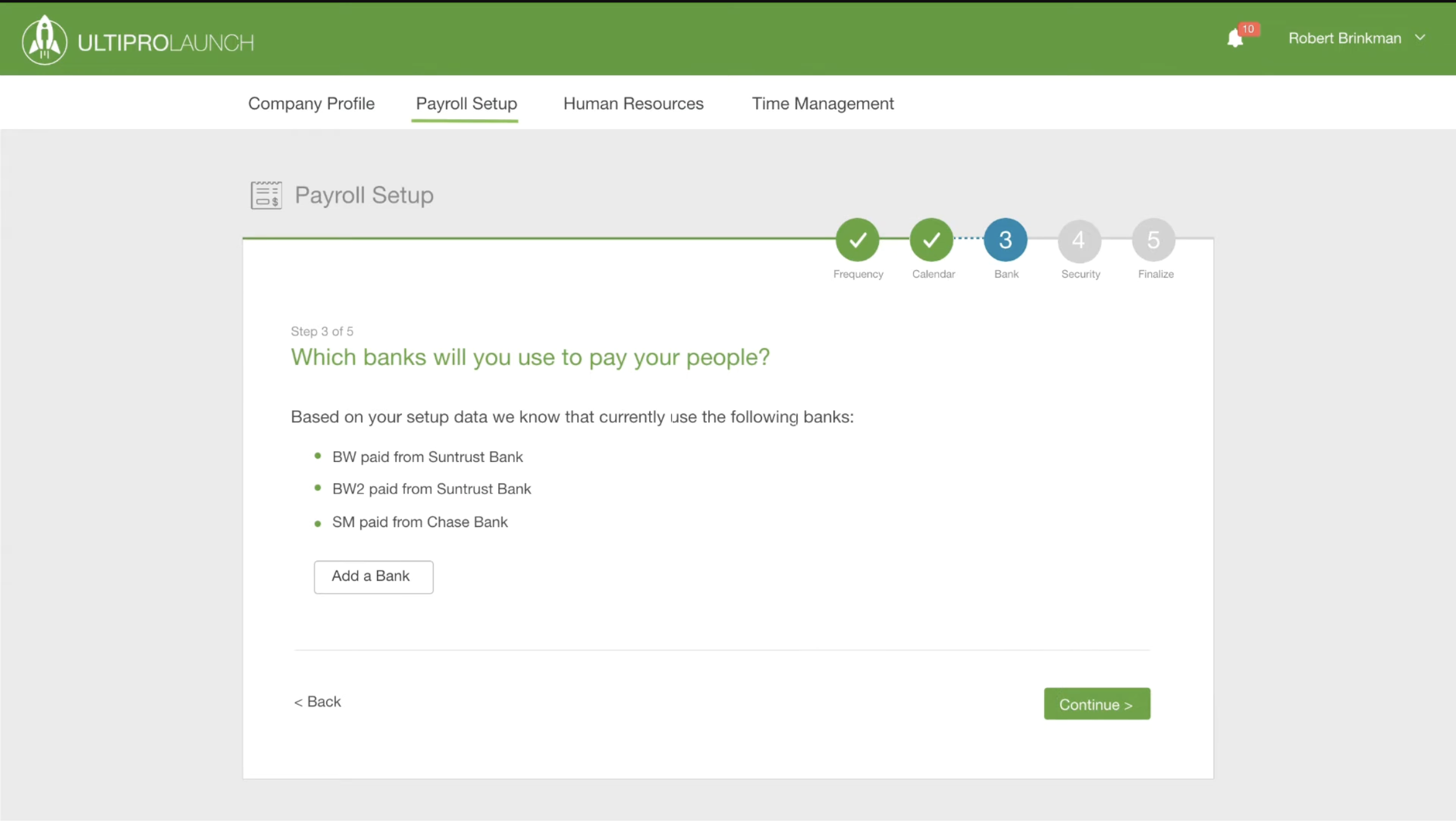
Concept for customer facing pages
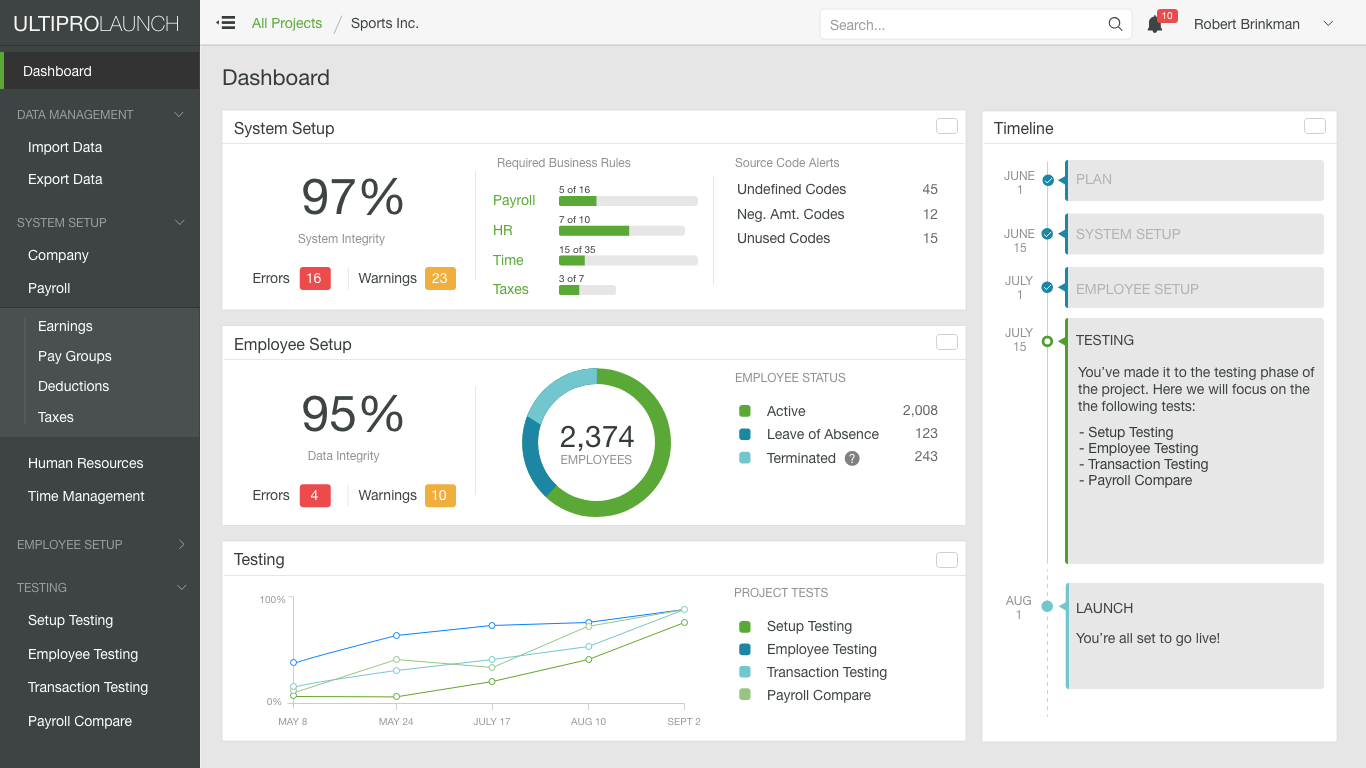
Concept for internal dashboard pages
What Happened Next
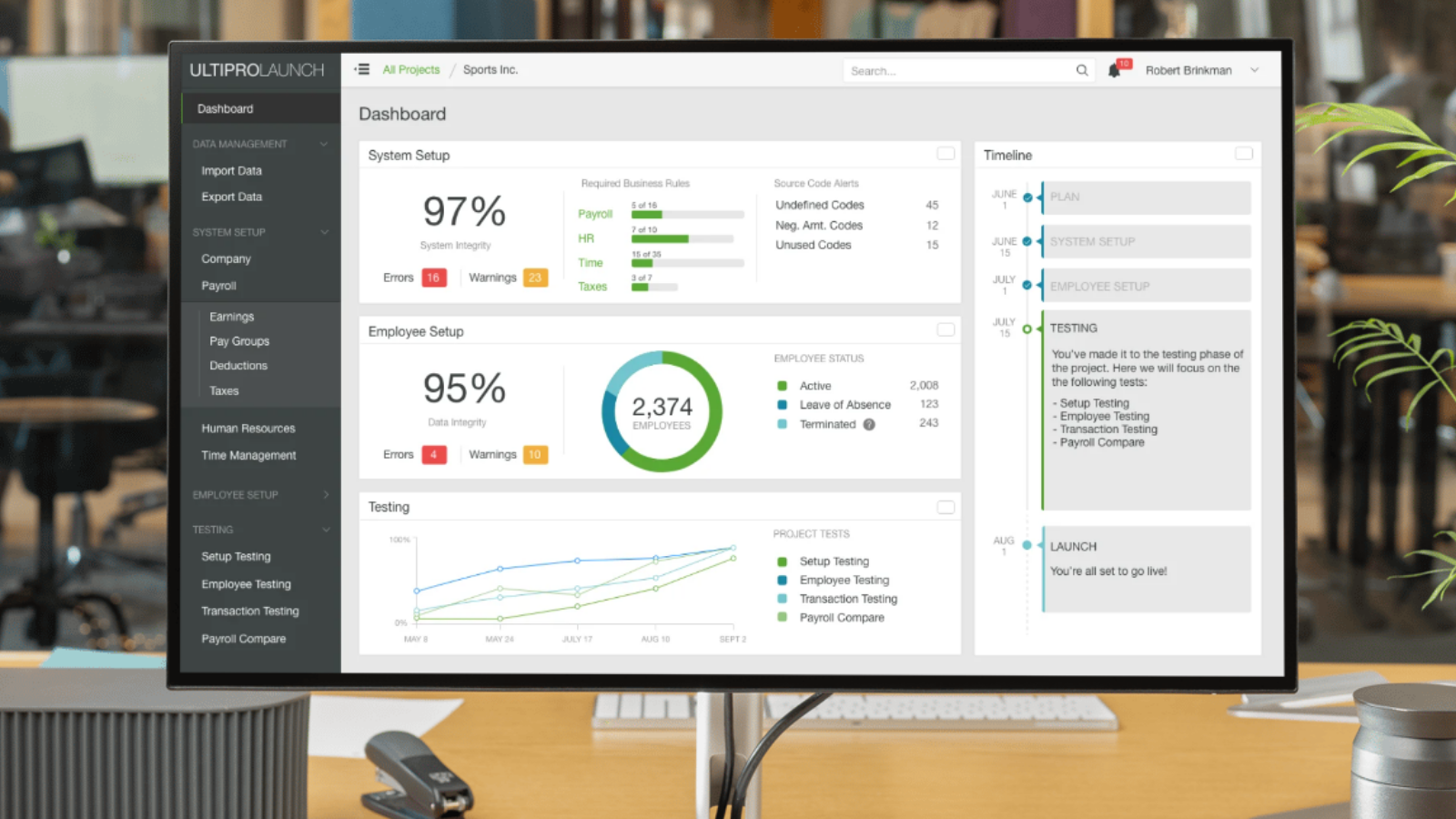
Ultimate continued developing the initiative after I rolled off the project and released it as UltiPro Launch in 2018. The released platform reflected the central direction established during the foundational phase: a guided, centralized experience that increased visibility, automated repetitive data work, and reduced customer effort.
Industry recognition
UltiPro Launch received a Gold Stevie Award in 2019 in the Migration as a Service category and a 2019 Brandon Hall Group Excellence in Technology Gold Award for Best Advance in Client Acquisition and Retention Technology. Ultimate announced the Brandon Hall recognition in January 2020.
Later Program Results
Because I was no longer on the team, I treat these as outcomes of the broader program rather than results attributable solely to my work. Public award and case-study materials later reported:
212 customers live, 14,674 files parsed, and 1,436,267 people-profile records processed during the first seven months.
Average deployment time reduced from six months to four.
Data collection and staging reduced from ten weeks to two.
Customer satisfaction increased from 57% to 69%, while NPS improved from -14.4 to 2.2.
Downstream support cases for newly live customers decreased by 24%.
The most important design challenge was not creating the interface. It was making a complex enterprise service understandable enough for customers, specialists, product teams, and engineers to act on together.
By translating fragmented research and operational knowledge into a shared model, experience principles, and phased product strategy, I helped establish the foundation for a product that continued after my departure and later earned significant customer results and industry recognition.